
HR Data
HR Data is at the centre of a new SENA (Sovereign Edge Network Architecture) business model, powered by the Holochain platform.
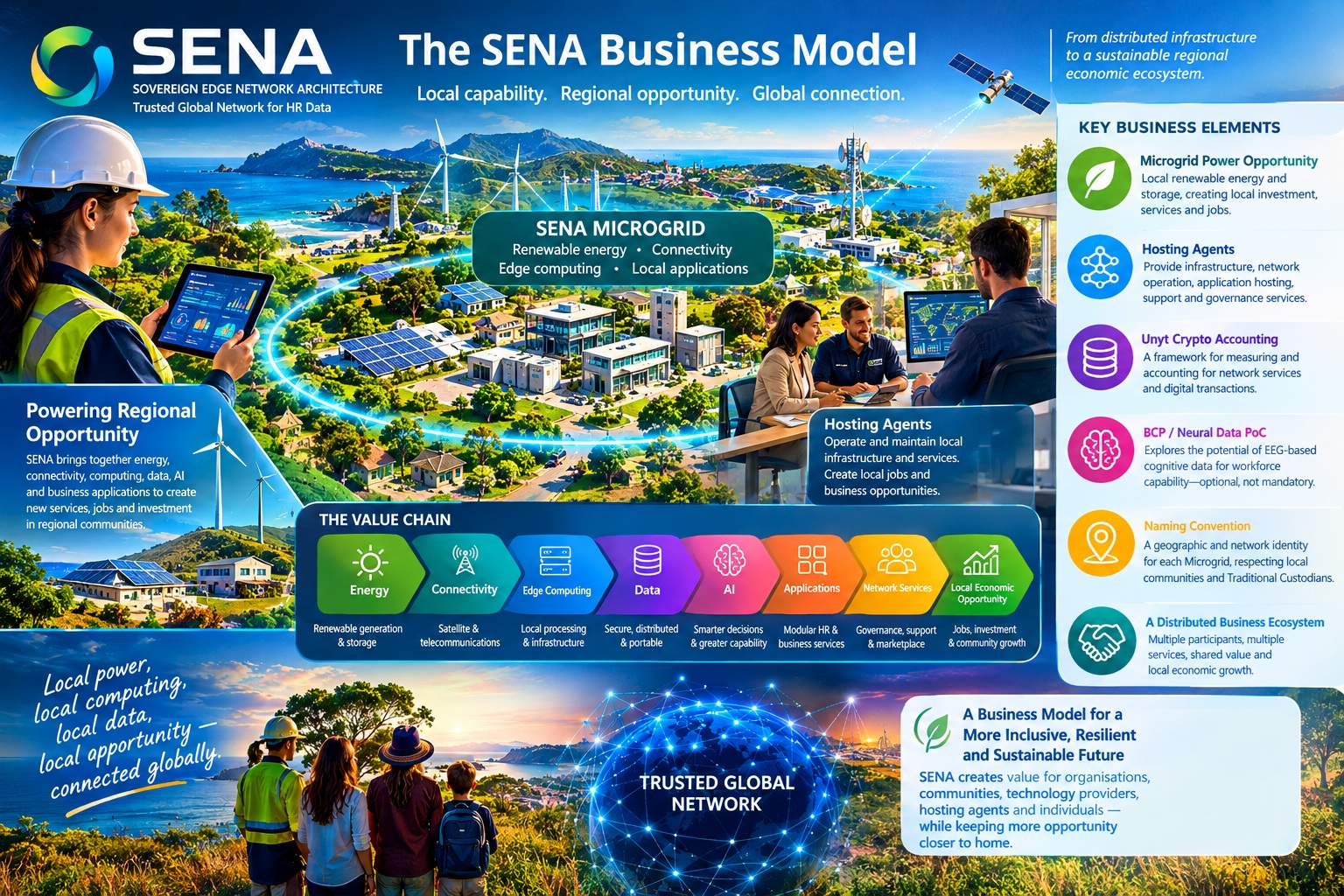
The Business component of the SENA Project is designed to turn distributed infrastructure into a sustainable regional economic ecosystem. A SENA Microgrid is not simply a technology installation; it creates an environment in which energy, connectivity, computing, data, AI and business services can come together to support local organisations, workers and communities while participating in a trusted global network.
Creating Local Economic Opportunity
Each SENA Microgrid can provide opportunities for local businesses and infrastructure operators to participate in the network. Renewable energy generation and battery storage can provide the power foundation, while telecommunications, satellite connectivity and Edge computing create the digital infrastructure required to support local applications and services.
This creates a potential Microgrid Power Opportunity: regional businesses, communities and infrastructure partners can invest in or operate local energy and computing capability and potentially provide services to organisations participating in the SENA Network. The model is intended to complement existing energy and telecommunications infrastructure rather than replace established providers, creating additional local capability and economic activity.
Hosting Agents and Network Services
SENA also creates a new role for Hosting Agents – local or regional organisations that can operate and maintain the technical infrastructure supporting a SENA Microgrid. Hosting Agents may provide services such as Edge computing, Holochain network operation, application hosting, technical support, governance administration and other agreed network services.
The intention is to establish a service-based economic model in which Hosting Agents can be compensated for the infrastructure and services they provide to participating organisations. This creates the possibility of a distributed network in which economic value is generated and retained closer to the communities where infrastructure and services are delivered.
Digital Settlement and the Unyt Framework
As distributed networks develop, conventional accounting and payment systems may need to accommodate new forms of digital service consumption. SENA is exploring the use of Unyt as a crypto-accounting framework to help Hosting Agents and participating organisations account for network services and digital transactions.
The objective is not to make cryptocurrency the focus of SENA. Rather, a digital settlement framework could provide a mechanism for measuring and accounting for services such as hosting, computing, network resources and AI-related consumption in a distributed environment. The commercial, accounting, taxation and regulatory treatment of any cryptocurrency or digital-token transactions would remain subject to the applicable jurisdiction and professional advice.
A Proof of Concept for Neural Data
The SENA business ecosystem can also support specialised applications that demonstrate the potential value of employee-controlled data. One example is the Baseline Cognitive Profile (BCP) proof of concept, which explores the potential use of EEG-derived neural signals alongside behavioural and occupational information.
The purpose of the PoC is to investigate how appropriately governed neural and cognitive information might contribute to workforce capability assessment while maintaining strong privacy and data-governance principles. Importantly, the BCP is an optional application and proof of concept – not a requirement for participation in SENA.
Its relevance to SENA is the underlying principle: highly personal information can potentially be processed at or near the individual’s Edge device, with the individual retaining control over what information is made available to an organisation. This illustrates the broader concept of Employee Data Ownership and Portability in an AI-enabled economy.
A Trusted Identity for Every Microgrid
A distributed network also needs a consistent way of identifying its regional participants. SENA therefore incorporates a geographic and network naming convention for SENA Microgrids.
Each Microgrid can have a persistent SENA identity that remains independent of the particular telecommunications, satellite, energy or technology providers operating within it. Provider-specific identifiers can be mapped to the SENA identity without allowing those providers to control the identity of the Microgrid itself.
The naming approach is also intended to respect local communities, Traditional Custodians and established regional identities. SENA does not seek to impose arbitrary names on places; rather, its naming framework can recognise the names by which regions are known, subject to appropriate local authority and cultural protocols.
Building a Distributed Business Ecosystem
The commercial opportunity created by SENA therefore extends well beyond selling software. It can involve:
Energy → Connectivity → Edge Computing → Distributed Data → AI → Applications → Network Services → Local Economic Opportunity
Different participants can contribute different capabilities. Energy providers can provide power; telecommunications and satellite companies can provide connectivity; technology companies can provide infrastructure and applications; Hosting Agents can operate local network services; organisations can deploy modular business applications; and individuals can participate with greater control over their own digital data.
The long-term objective is to create a distributed business ecosystem in which value can be created locally while remaining connected globally.
From Infrastructure to Opportunity
SENA’s business proposition can be expressed simply:
Build local capability. Connect it globally. Create new services. Keep more opportunity closer to the communities that generate it.
The SENA Microgrid is therefore both a technical infrastructure model and a potential economic development platform – providing the foundation for new forms of energy, digital services, AI, employment technology and employee-controlled data in the emerging distributed economy.